Master’s in Telecommunication Systems
Head of Specialization
- Prof. Dr. Bakri Yamina
- Rank: Professor of Higher Education
y.bekri@cu-maghnia.dz
Objectives
The presentation of this training program in Telecommunication Systems falls within the field of Science and Technology (ST), responding to an urgent desire among Bachelor’s students to continue their university studies within their institution.
This specialization combines theoretical precision and applied depth to train qualified engineers and researchers capable of leading modern telecommunications projects and contributing to the national digital transformation. Its objectives are summarized in three main axes:
1. Academic and Cognitive Objectives (Scientific Deepening):
- Mastering Advanced Communications: Comprehending signal processing theories, digital communications, MIMO systems, and access technologies (CDMA/OFDM).
- Infrastructures and Wave Propagation: Studying antennas, transmission lines and waveguides, and satellite links.
- Network Engineering and Multimedia: Understanding modern generation protocols (3G, 4G, 5G), cognitive radio, and multimedia.
- Modeling and Simulation: Acquiring rapid programming skills using modern tools such as Matlab/Simulink, Cisco Packet Tracer, and FPGA boards.
2. Professional and Applied Objectives (Professional Competencies):
- Network Management and Design: Qualifying cadres capable of designing and analyzing the performance of fixed and mobile operator networks.
- Frequency Engineering and Optical Transmission: Gaining expertise in fiber optic systems, EDFA amplifiers, and radio frequency (RF) microwave devices.
- Information Systems Security: Controlling telecommunications security and protecting embedded systems and the Internet of Things (IoT) from vulnerabilities.
- Project Management and Communication: Empowering individuals to lead projects independently, master technical English, and adhere to professional ethics and intellectual property.
3. Strategic and Developmental Objectives (National and Local Impact):
- Supporting Digital Transformation: Accompanying digitization plans in Algeria by integrating artificial intelligence into infrastructures and smart cities.
- Meeting the Needs of Economic Partners: Equipping the market with engineers for the benefit of national institutions, such as:
- Telecommunications Sector: Algérie Télécom, Mobilis, Djezzy, and Ooredoo.
- Industrial and Energy Sector: Sonatrach, Sonelgaz complexes, and the National Corporation for Electronic Industries (ENIE).
- Public Bodies: Ministry of Interior, Ministry of National Defense, Telediffusion Algérienne (TDA), and local authorities (Maghnia Municipality and Tlemcen Province).
- Bridge to Scientific Research: Establishing a solid academic foundation for students wishing to pursue doctoral studies to support research laboratories with local and innovative technological solutions
Targeted Audience
This category includes students who have completed their undergraduate studies in the first cycle (Bachelor’s) and wish to deepen their knowledge to acquire higher competency:
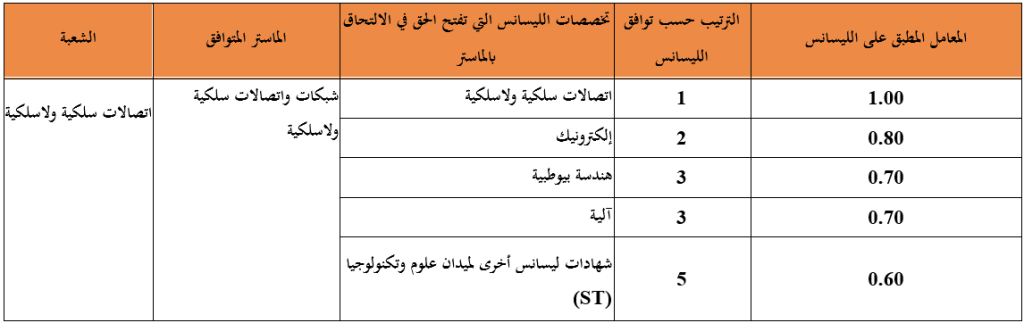
Admission Requirements
The University Centre of Maghnia offers the opportunity to enroll in its undergraduate programs (Bachelor’s degree) for various categories of both Algerian and international students, in accordance with the applicable regulatory terms and conditions:
- High School Graduates (Baccalaureate Holders) Prospective students holding a Bachelor’s degree (Baccalaureate) or an equivalent international qualification may apply according to the criteria and procedures updated annually by the Algerian Ministry of Higher Education and Scientific Research.
- Holders of Prior University Degrees (Classic System)
Candidates seeking to advance their studies or specialize further may apply based on available pedagogical capacity and ministerial guidelines. This includes:
- Holders of Prior University Degrees License degree (Classic System).
- Holders of the DEUABaccalaureate + 3 years Classic System)
- Second Degree Candidates
Students who already hold a university degree may apply for a second degree programsubject to seat availability and specific departmental requirements
- International Students (“Study in Algeria” Program)
UCM warmly welcomes international applicants. Admission is granted based on the following:
- The candidate must hold a degree in Baccalaureate degree or an internationally recognized equivalent
- Registration via the official ““Study in Algeria”” (Study in Algeria).
- Prior attainment of an Equivalence Certificate from the Algerian Ministry of Higher Education and Scientific Research.
Important Notes Regarding Tuition Fees:
- Tuition-Free: Education is free for Algerian residents and international students receiving official scholarships from the Algerian Ministry of Higher Education
- Fee-Paying: International students under the “Study in Algeria” program (non-scholarship) are subject to annual fees fees covering tuition, accommodation, and catering, determined by current regulatory decrees.
Structure and Organization of the Training Programme
The Master’s program in Telecommunication Systems in Algeria under the LMD (Licence, Master, Doctorate) system spans two academic years distributed across four semesters (First Semester, Second Semester, Third Semester, and Fourth Semester). The structure of this training relies on a precise balance between in-depth theoretical lessons, practical work, and digital simulation, culminating in an applied and research graduation project at the heart of the specialization.
Time Structure and Semesters
The academic track consists of 120 credits, divided equally between the two years (60 credits per year, averaging 30 credits per semester):
- First Year (Master 1): Focuses on building an advanced scientific foundation and deepening core concepts in signal processing and telecommunications engineering.
- First Semester: Students study core modules such as advanced digital communications, random signals, wireless communications, and programmable logic devices.
- Second Semester: Dedicated to digital signal processing, antennas, transmission channels, as well as information coding and compression techniques.
- Second Year (Master 2): Directed toward specialized study, complex network analysis, and field application.
- Third Semester: Focuses on next-generation wireless and mobile networks, optical communications, multimedia technologies and protocols, alongside very high frequency (VHF/UHF) and radio frequency (RF) components and devices.
- Fourth Semester: Entirely dedicated to preparing the end-of-study graduation project in the form of a thesis, accompanied by a practical internship within an economic institution or a university research laboratory.
Organization of Teaching Units
Modules in each semester are divided into four teaching units in accordance with Algerian university legislative organization and the official training program:
a. Fundamental Teaching Units These units form the backbone of the specialization and command the largest share of credits and coefficients to ensure the acquisition of core knowledge:
- Advanced digital communications and random signals.
- Wireless communications and programmable logic devices.
- Digital signal processing and antennas.
- Transmission channels, coding, and compression.
- Wireless and mobile networks and optical communications.
- Multimedia technologies and protocols, and very high frequency components and devices.
b. Methodological Teaching Units Aimed at equipping students with simulation tools, software analysis, and scientific experimentation through dedicated practical work:
- Practical work in advanced digital communications, random signals, programmable devices, signal processing, antennas and transmission channels, coding and compression, mobile networks, and optical communications.
- Object-oriented programming (C++).
- Image processing and digital television.
c. Exploratory Teaching Units: Standards and protocols.
d. Transversal Teaching Units Equip students with the linguistic, ethical, and methodological skills necessary for their academic and professional paths: technical English and terminology; ethics, professional deontology, and intellectual property; documentary research and thesis design.
Evaluation and Progression System
- Continuous Assessment: Accounts for 40% of the total grade for theoretical modules (including quizzes, assignments, and technical sheets for mini-projects). Practical work undergoes 100% continuous assessment.
- Final Exams: Administered at the end of each semester, weighing 60% of the grade for fundamental and methodological modules.
- Remediation and Progression: Progression is subject to prevailing regulatory laws; the compensation principle is applied between modules within the same teaching unit, as well as across different units within the same semester. A semester is considered definitively acquired if the general average equals or exceeds 10/20.
Culmination of Training (Fourth Semester)
The study path concludes with the preparation and defense of a Master’s thesis (its 30 credits are distributed across personal work, internship, and seminars). Graduation topics typically revolve around contemporary technical issues:
- Applied field study in cooperation with an economic partner: (such as Algérie Télécom, mobile operators like Mobilis, or the National Corporation for Electronic Industries). Topics include planning and optimizing 4G and 5G network performance, internet protocol management, or maintaining fiber optic infrastructures.
- Academic study and digital simulation: Wireless channel modeling, designing smart microwave antennas (Multiple-Input Multiple-Output – MIMO), medical signal or image processing, and developing intelligent algorithms for the Internet of Things, using simulation software such as Matlab and Simulink inside research laboratories.
Awarding of Degree: Following a public defense before a jury of specialized professors to evaluate the scientific background and quality of the presentation, the student is awarded the Academic Master’s degree in Telecommunication Systems. This degree directly opens doors for graduates to enter the job market as engineering cadres in major technological companies, or to continue their research path by participating in the doctoral admission competition
Targeted Knowledge
Based on the official ministerial training program for the Telecommunication Systems specialization at the University Center of Maghnia, the targeted knowledge and learning outcomes acquired by students by the end of this cycle are divided into several precise cognitive and scientific axes:
1. Targeted Theoretical and Fundamental Knowledge:
- Mastering the mathematical modeling of signals: Acquiring the ability to analyze and process random signals and stochastic processes used in contemporary transmission and communication systems.
- Comprehending advanced transmission and digital communication techniques: In-depth understanding of digital modulation mechanisms and how to calculate error probabilities in the presence of noise and multi-path channels.
- Understanding antenna physics and wave propagation: Studying the radiation characteristics of antennas and modeling wireless transmission channels to understand the impact of fading and signal interference.
- Mastering data coding and compression theories: Comprehending source coding (compression) and channel coding techniques to ensure data protection and rapid transmission.
2. Technical and Applied Knowledge and Skills:
- Design and simulation of electronic communication systems: The ability to program and develop logic circuits and embedded systems using Field Programmable Gate Arrays (FPGAs) and Hardware Description Languages (VHDL).
- Wireless and mobile network planning and engineering: Acquiring knowledge related to the architecture and protocols of modern mobile phone generations and wireless local area networks, alongside frequency allocation and data flow management.
- Control of optical communication and high-frequency systems: Understanding the operation of optical fibers and very high-capacity data transmission systems, alongside studying passive and active components of microwave and radio frequency (RF) devices.
- Mastering multimedia and digital signal processing: The ability to apply digital image processing algorithms, digital television systems, and multimedia systems.
3. Methodological Knowledge and Simulation Tools (Research and Development Skills):
- Using engineering programming and digital simulation: Proficiency in object-oriented programming (such as C++) and complete mastery of standard telecommunications engineering simulation software, such as MATLAB/Simulink, to analyze systems and test algorithms prior to hardware implementation.
- Documentary research and drafting scientific reports: Acquiring the methodology for reference retrieval, preparing research papers, and designing engineering graduation theses (PFE) in an organized academic manner.
4. Exploratory and Transversal Knowledge (Professional Integration):
- Familiarity with emerging technologies: Studying radar techniques, satellite radio navigation (such as GPS and Galileo systems), embedded systems, and Electromagnetic Compatibility (EMC).
- Language and communication: Proficiency in technical terminology in English as the primary working language for research and development in telecommunications and technology.
- Commitment to professional ethics: Understanding the principles and ethics of scientific research, academic integrity, and intellectual property and patent rights.
Competencies to be Acquired
The second cycle (Master’s) in the Telecommunication Systems specialization focuses on transforming the theoretical knowledge you have acquired into professional and practical competencies (Compétences visées), directly qualifying you to lead projects in the industrial sector or excel in scientific research laboratories.
The key competencies you will gain from this specialization include the following:
- Personal, technical, and scientific project management: Acquiring scientific methodology and the ability to plan, manage, and direct individual and technological projects with high efficiency.
- Infrastructure and network services management: Full capability to operate, manage, and maintain complex telecommunications infrastructures and their associated services.
- Design of fixed and mobile operator networks: Gaining engineering and structural design skills for telecommunications networks belonging to fixed and mobile telephony and internet operators.
- Performance analysis of fixed and mobile operator networks: Skill in diagnosing quality of service, troubleshooting, analyzing network capacity and data flow, and evaluating their overall performance.
- Leading and directing operator network deployment operations: Field and engineering supervision over the deployment and expansion of fixed and wireless telephony and internet network infrastructures.
- Digital telecommunication signal processing: Applied and software mastery of signal processing algorithms and improving data transmission quality in advanced digital communication channels.
- System and telecommunications security control: Complete mastery of the scientific, technological, and regulatory aspects required to ensure the protection and security of telecommunications networks and data exchanged across them.
- Enterprise network organization and IoT application deployment: The ability to design and structure communication networks within enterprises, and deploy innovative Internet of Things (IoT) applications based on artificial intelligence technologies.
These integrated competencies ensure the preparation of qualified graduates ready for immediate integration into the professional and technical environment of the telecommunications sector, or successful continuation of academic research at the PhD level.
Internships & Capstone Projects
Internships and supervised projects in the third year of the Bachelor’s degree and the second year of the Master’s degree represent a pivotal stage mandatory They aim to bridge the gap between theory and practice, through which the student acquires Practical skills and knowledge in-depth knowledge by implementing scientific methodologies within the work environment, and developing professional competencies such as real-world problem-solving and effective project management
this experience also contributes to refining Behavioral Competenciessuch as effective communication and teamwork under specialized academic and professional supervision. It also serves as a pivotal opportunity for students to build a professional network and enhance their autonomy, ensuring a smooth transition and high readiness for integration into the labor market
Career Prospects
Based on the aligned ministerial training program, graduates of the Master’s in Telecommunication Systems (Systèmes des Télécommunications) possess wide opportunities for employment and professional integration.
The career prospects (Débouchés professionnels) available to them upon graduation are distributed across several vital sectors in the national and international markets, spanning the following roles and sectors:
Target Positions:
- Network Planning & Optimization Engineer: Supervising frequency planning, base station distribution, and improving connection quality and data flow for mobile networks (4G/5G).
- Network Maintenance Engineer: Managing critical telecommunications infrastructures, maintaining fiber optic networks, coaxial cables, and microwave systems.
- IoT & Embedded Systems Engineer: Designing and developing smart systems and connected devices based on signal processing and artificial intelligence across various industries.
- Telecom Security Engineering Cadre: Protecting and securing data transmission channels and enterprise networks against breaches and electromagnetic interference.
Employment Sectors and Economic Partners in Algeria:
- Telecommunications and Mobile/Internet Operators: Algérie Télécom across its branches (fixed, mobile, satellite). The three mobile network operators: Mobilis, Djezzy, and Ooredoo. The Post and Electronic Communications Regulatory Authority (ARPCE).
- Industrial and Technological Sector: The National Corporation for Electronic Industries in Sidi Bel Abbès (ENIE). Algerian Radio and Television Broadcasting companies (TDA). Petroleum and energy institutions that rely on private and complex communication networks (such as Sonatrach and Sonelgaz).
- Transportation and Navigation Sector: Airlines and airports (supervising radar, radio navigation, and satellite systems). Railway transport companies (SNTF) and the Algiers Metro for managing specialized signaling and wireless control communications.
- Administrations, Ministries, and Banking Corporations: National wire and wireless telecommunications directorates. Management and operation of data centers and internal networks for banks and major government institutions.
- Startup Creation: Thanks to the training students receive in “Entrepreneurship and Project Management,” graduates can innovate technical solutions specific to the Internet of Things or multimedia applications, and establish their own ventures with support from university business incubators.
Academic and Research Prospects:
- Pursuing Graduate Studies (Doctorate): This academic degree allows top-performing students to pass the doctoral entrance competition to join university research laboratories, working on developing sixth-generation (6G) technologies, advanced image processing, and smart radar systems, qualifying them in the future for a career in teaching and scientific research at the university.
Postgraduate Opportunities
This training opens broad horizons for students wishing to deepen their academic path, as the Master’s degree provides its holders with the following opportunities
- Post-Graduate Studies in Algeria (Doctorate/PhD)
The current training program allows for participation in national competitive exams for doctoral programs offered by Algerian university institutions, whether in the original specialization or in other specializations within the same field of study
- Global Mobility & Scholarships
Distinguished students can aspire to pursue their postgraduate studies in Prestigious foreign universitiesthrough two pathways:
- Official Partnerships: Within the framework of international cooperation programs and scholarships established by the Algerian Ministry of Higher Education and Scientific Research with partner countries
- Individual Application: Students are eligible for direct enrollment in international universities, in accordance with the academic standards and criteria set by those educational institutions abroad
Career Readiness
The Job Club at UCM (Job Club) at the University Centre of Maghnia, the primary interactive space for preparing students to enter the professional world. Its role extends beyond the academic aspect to focus on Professional Empowerment Through intensive training in self-marketing techniques, professional CV writing, and confidently navigating job interviews
The club serves as a true bridge connecting graduates to the labor market, providing them with the necessary tools to explore opportunities and build a professional network. This helps narrow the unemployment gap and ensures a swift and successful transition from the classroom to promising career paths
Support for Entrepreneurial Projects
The University Centre of Maghnia serves as a fertile environment for innovation, where efforts have converged to establish an integrated ecosystem for supporting entrepreneurial thinking, led by The University Business Incubator Which works on mentoring innovators and startups from the ‘ideation’ stage to ‘implementation,’ by providing high-quality coaching and specialized consultations to obtain the ‘Innovative Project’ label
Alongside it, stands out Entrepreneurship Development Center (CDE) As a strategic link for developing students’ entrepreneurial skills, in partnership with the National Entrepreneurship Support and Development Agency (NESDA), it focuses on practical training and technical mentorship. The center also includes Technology and Innovation Support Centre (CATI) which ensures the protection of intellectual property and patents
These entities integrate to form a bridge connecting the university to the economic environment, thereby transforming academic projects into promising economic enterprises that contribute to local and national development. This establishes the University Centre of Maghnia as a true hub for shaping the entrepreneurs of tomorrow