Facts & Figures
A brief overview of the key metrics for the Institute of Science and Technology.
Institute of Sciences and Technology
About the Institute
The Institute of Science and Technology commenced its academic programs during the 2016-2017 academic year, initially offering a specialty in Hydraulics. At the beginning of the 2022-2023 academic year, the curriculum was expanded to include specialities in Civil Engineering, Mechanical Engineering, and Telecommunications Engineering.
The academic programs offered at the Institute are deeply aligned with the general development strategy of the region. Furthermore, a number of partnership agreements have been established with various universities and socio-economic partners aimed at enhancing the training experience for the Institute’s students. Through this active role, the Institute serves as a beacon of scientific and cultural excellence within the Maghnia University Centre.
The Institute is staffed by 43 permanent professors and approximately 5 temporary lecturers. In addition, the support team includes 11 administrative and service staff members, as well as contract employees. Together, they serve a student body of approximately 350 students across both the Bachelor’s and Master’s degree programs.
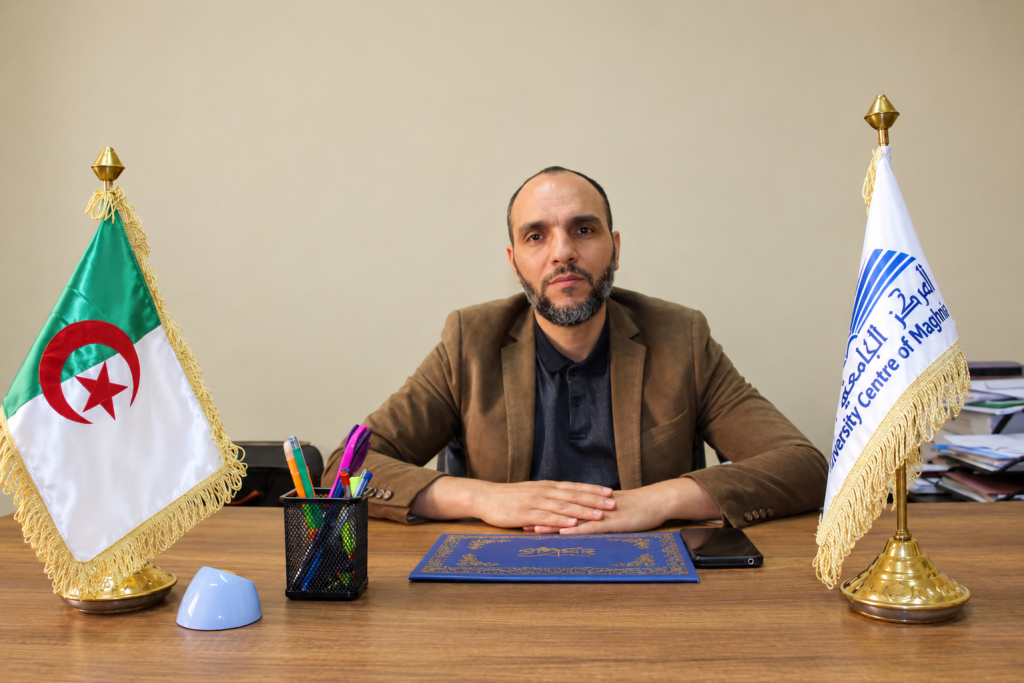
Director of the Institute of Science and Technology
Word from the Director
Dr. Amine Guiz
In the Name of Allah, the Most Gracious, the Most Merciful. Praise be to Allah, the Lord of the Worlds, and peace and blessings be upon the most noble of prophets and messengers, our Prophet Muhammad, his family, all his companions, and those who follow them in righteousness until the Day of Judgment.
Imam Al-Shafi’i, may Allah have mercy upon him, said: “Knowledge is not what is memorized; knowledge is what benefits.”
We are delighted to welcome you all to this pioneering scientific and technological institution. We believe in the power of science and technology to achieve progress and development, and we work diligently to provide a stimulating educational and research environment that enables students and staff to reach their full potential.
At the Institute of Science and Technology at the Maghnia University Centre, we strive to offer distinguished educational programs that provide students with limitless opportunities to acquire knowledge and develop the skills necessary to keep pace with modern advancements in the fields of science and technology.
Whether you are professors, students, or administrative staff, you are an integral part of our scientific and educational community, and we are committed to supporting you and helping you achieve success and excellence.
We look forward to an exciting journey full of challenges and achievements, and we hope you will be an active part of our path toward excellence and innovation in the fields of science and technology.
Welcome once again to the Institute of Science and Technology.
Thank you.
About the Institute
Academic Programs at the Institute
The Institute of Science and Technology offers a diverse range of scientific and technological specialties, aiming to equip students with the necessary knowledge and skills across various fields.
–Common Core in Science and Technology: Upon successful completion of the first year in the Science and Technology Common Core, students are oriented toward their second year in one of the following specialties: Hydraulics, Civil Engineering, Mechanical Engineering, or Telecommunications Engineering.
– Undergraduate Level (Bachelor’s): The Institute currently provides undergraduate education in accordance with the LMD (Licence, Master, Doctorate) system. The undergraduate program spans three years and culminates in a Bachelor’s degree (Licence).
– Master’s Level: Following their Bachelor’s degree, students may choose to pursue a two-year Master’s degree in one of the following specialties: Civil Engineering (Structures specialization) or Urban Hydraulics.
– Postgraduate Level (Doctorate): At the postgraduate (Doctoral) level, there are currently 6 doctoral students undertaking their research and training in the Hydraulics specialty.
The Role of the Institute
The Institute of Science and Technology is an educational institution dedicated to developing students’ scientific and technological skills and promoting scientific research across various disciplines. The Institute offers educational programs and training courses in multiple specialties, with a particular focus on engineering.
The primary aim of the Institute of Science and Technology is to equip students with the essential knowledge and skills required to keep pace with modern advancements in the world of technology.
To achieve this, the Institute offers diverse academic programs that culminate in Bachelor’s and Master’s degrees across various technical and scientific fields, as well as Doctoral degrees specifically in the Hydraulics specialty. Furthermore, the Institute fosters a dynamic research environment that encourages scientific discovery and innovation through active research projects and scientific experiments.
Institute Strategy
The Institute serves as a hub for education and knowledge, facilitating the establishment of strong relationships with civil society actors and local economic institutions. These partnerships are bridged by the academic specialties taught at the Institute, namely Hydraulics, Civil Engineering, Mechanical Engineering, and Telecommunications.
The Institute’s management team strives to ensure quality and effectiveness while fostering partnerships at the local, national, and international levels. Furthermore, the Institute provides an open and supportive environment for student entrepreneurs and project holders. To this end, a Support and Innovation Center, along with a Scientific Club, have been established within the Institute.
Functional and Organizational Structure of the Institute of Science and Technology
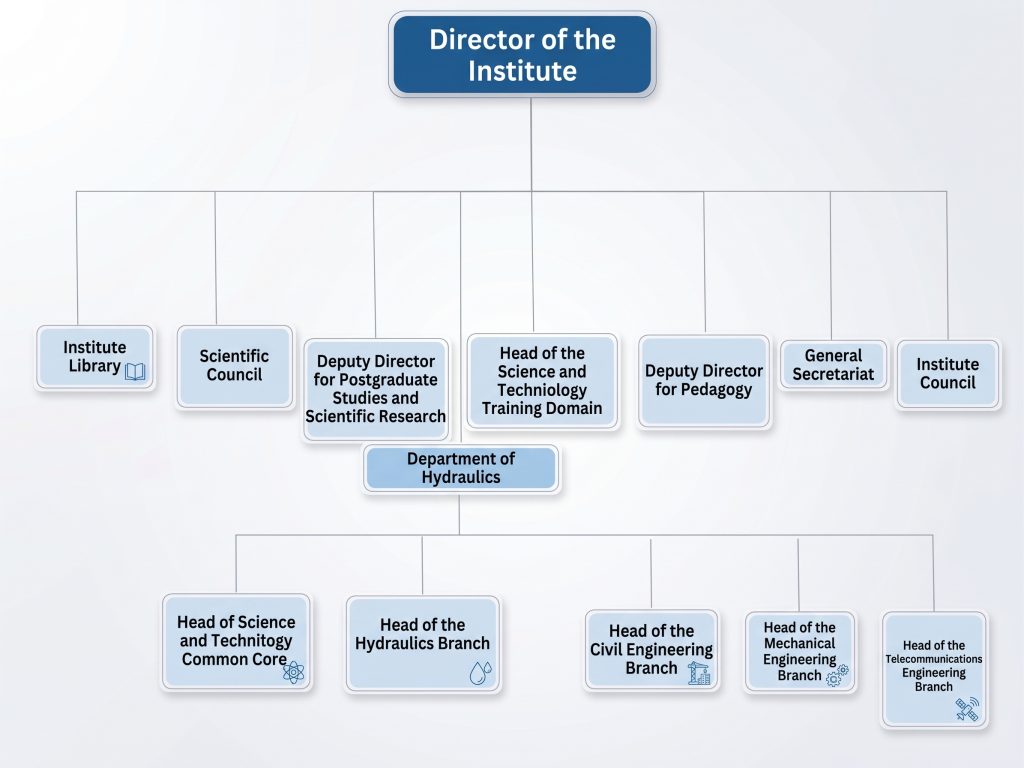
The Institute of Science and Technology features an effective functional organization designed to foster collaboration and interaction among its various departments. The Institute’s organizational structure consists of several core departments that work in harmony, playing a pivotal role in achieving the Institute’s designated objectives.
This structure is characterized by its flexibility and adaptability to modern challenges in the fields of science and technology. Such adaptability contributes to the delivery of high-quality educational and research programs that meet the needs of students as well as the local and global communities, thereby promoting development and innovation across various scientific and technical disciplines.
Specializations
With the rapid growth in student enrollment in the field of science and technology, the foundational technological education domain provides training for first-year students in “Science and Technology.” This first year is a common core across all branches.
Upon successful completion of the first year in the Science and Technology Common Core, students are oriented toward their second year in one of the following specialties: Hydraulics, Civil Engineering, Mechanical Engineering, or Telecommunications Engineering.
The Institute currently offers undergraduate programs under the LMD (Licence, Master, Doctorate) system. Undergraduate studies span three years and culminate in a Bachelor’s degree (Licence).
Following this, based on their preference, students may choose to pursue a two-year Master’s degree in one of the following specialties: Civil Engineering (Structures specialization) or Urban Hydraulics.
Algeria is situated in a region that frequently faces water scarcity and irregular fluctuations in water resources. Furthermore, the risks associated with these resources—concerning both quantity and quality—continue to grow in national importance, driven by the combined momentum of population growth (urban development) and the increasing water demands of the agricultural sector (which alone consumes approximately 70% of withdrawn water). Consequently, the sustainable development of agriculture, as well as other industrial and urban sectors in our country, faces a direct threat from the irregular supply of this strategic resource.
As a result, public authorities and private companies operating in the fields of water management, agriculture, and urban planning have an urgent and growing need for skilled professionals. These professionals must master the technical and scientific tools required to achieve the optimal qualitative and quantitative management of this strategic resource.
To meet the expectations and requirements of these various socio-economic partners, the university offers this Bachelor’s (Licence) program in Hydraulics and continuously works to expand the prospects of this specialty.
Through this specialized training, students who earn their Bachelor’s degree can either pursue further studies at the Master’s level or enter the professional workforce in the following areas:
– Water mobilization and management
– Management of water-related risks
– Urban planning and development
– Rural development
– Design and construction of various hydraulic structures
Since its inauguration in the 2022/2023 academic year, the primary objective of the Civil Engineering program offered by the Institute of Science and Technology at the Maghnia University Centre has been to prepare future skilled professionals and practitioners equipped with the scientific and technical skills necessary to meet the expectations of the construction and structural engineering sector.
The program offers a Bachelor’s degree (Licence) in Civil Engineering, a Master’s degree in Structures, and a State Engineer degree in Civil Engineering. This academic pathway also provides opportunities to obtain higher diplomas and pursue Doctoral studies across various civil engineering specialties.
Our Centre aspires to become one of the leading institutions in the country within this sector by drawing on the skills and expertise of its multidisciplinary faculty. Composed of research professors across various academic ranks, the faculty ensures exceptional supervision and delivers comprehensive academic programs. These programs are conducted through lectures, tutorials, practical coursework, and field visits to various project sites, all complemented by practical internships in professional environments and senior design projects.
Mechanical engineering is a branch of engineering dedicated to the design, assembly, manufacturing, and operation of engines, machinery, and mechanical systems. It focuses primarily on the principles of force and motion, encompassing key disciplines such as thermodynamics, materials science, and fluid mechanics. Mechanical engineers design, develop, test, and manufacture a wide array of mechanical devices and systems, including engines, machines, and structures, spanning across automobiles, aircraft, and all means of transportation and manufacturing.
Accordingly, the vision of the Institute of Science and Technology at the Maghnia University Centre is to graduate mechanical engineers trained in accordance with the latest global scientific curricula. The Institute achieves this by offering high-quality engineering programs and services that provide students with a broad and robust knowledge base in their specialization.
The program fosters a spirit of innovation and experimentation through the execution of practical scientific projects. Students are equipped with the essential analytical, experimental, computational, and methodological tools required to identify, formulate, and solve complex engineering problems.
Consequently, our graduates are well-prepared to execute various engineering projects demanded by the labor market, making active contributions to the implementation of developmental projects. Furthermore, the curriculum provides students with the optimal preparation to pursue postgraduate studies and scientific research in the field of mechanical engineering.
Wired and wireless communication systems constitute the vital fabric of modern connectivity. Wired communications enable the high-speed transmission of data via cables and optical fibers, encompassing internet infrastructure, coaxial networks, and optical networks. Conversely, wireless communications rely on electromagnetic waves and frequencies to connect across vast distances, utilizing radio networks, satellites, Wi-Fi, and other mediums.
Students pursuing a specialty in telecommunications focus on acquiring in-depth technological knowledge and mastering various software associated with communication devices, including smartphones, computers, and digital electronic communication systems.
The field of telecommunications engineering is undergoing extensive and rapid evolution. This is driven by our growing demand for novel technologies that streamline our daily lives and accelerate business operations—such as the widespread implementation of 5G technology across several developing nations starting in 2025.
Heads of Branches

BOURDIM Sidi Mohammed El Amine
Head of the Domain
DIF Zouheyr
Head of the Civil Engineering Branch
BENAYAD Zouaoui
Head of the Mechanical Engineering Branch

BEKRI Yamina
Head of the Telecommunications Branch
GHERISSI Radia
Head of the Hydraulics Branch
Administrative Staff

GUIZ Amine
Director of the Institute
a.guiz@cu-maghnia.dz
BELMAHI Samir
Head of Department
s.belmahi@cu-maghnia.dz
HAMRA Mohammed Amine
Deputy Director for Undergraduate Studies.
m.hamra@cu-maghnia.dz
HADJ DJELLOUL Mohammed
Deputy Director for Postgraduate Studies and Scientific Research.
m.hadjdjelloul@cu-maghnia.dz
Faculty Members of the Institute of Sciences and Technology
BEKRI Yamina
Telecommunications
y.bekri@cu-maghnia.dz
MOKHDAR Amal
Telecommunications
a.mokhdar@cu-maghnia.dz
BELHADI Siham
Telecommunications
siham.belhadi@cu-maghnia.dz
KHEDIM Farah
Telecommunications
f.khedim@cu-maghnia.dz
TOUAOULA Hachem
Electronics
h.touaoula@cu-maghnia.dz
GUENINECHE Lotfi
Electronics
l.guenineche@cu-maghnia.dz
GAOUAR Imad Eddine
Informatics
i.gaouar@cu-maghnia.dz
HOUALEF Meriem
Mathematics
m.houalef@cu-maghnia.dz
CHOUAOU Fatiha
Mathematics
f.chouaou@cu-maghnia.dz
HAMRA Mohammed Amine
Mathematics
m.hamra@cu-maghnia.dz
DIB Fatima
Mathematics
fatima.dib@cu-maghnia.dz
SARI Aouatef
Physics
a.sari@cu-maghnia.dz
BENMANSOUR Salima
Physics
s.benmansour@cu-maghnia.dz
HOUARI Ahmed
Physics
a.houari@cu-maghnia.dz
ZENASNI Hocine
Physics
h.zenasni@cu-maghnia.dz
KHELASSI Asma
Chemistry
a.khelassi@cu-maghnia.dz
BENOMARI Fatima Zahra
Chemistry
f.benomari@cu-maghnia.dz
AINSEBA Nabila
Chemistry
n.ainseba@cu-maghnia.dz
BENYAHIA Nacera
Chemistry
n.benyahia@cu-maghnia.dz
MAHROUG Hanane
Chemistry
h.mahroug@cu-maghnia.dz
FELLAH Amel
Process Engineering
a.fellah@cu-maghnia.dz
BOURDIM Mokhtar
Mechanical Engineering
m.bourdim@cu-maghnia.dz
FODIL Mohamed El Amine
Mechanical Engineering
m.fodil@cu-maghnia.dz
MAACHOU Sofiane
Mechanical Engineering
s.maachou@cu-maghnia.dz
BENAYAD Zouaoui
Mechanical Engineering
z.benayad@cu-maghnia.dz
BENDERMEL Othman
Mechanical Engineering
o.bendermel@cu-maghnia.dz
MEBAREK Hocine
Mechanical Engineering
h.mebarek@cu-maghnia.dz
GUIZ Amine
Civil Engineering
a.guiz@cu-maghnia.dz
BOURDIM Sidi Mohammed El Amine
Civil Engineering
s.bourdim@cu-maghnia.dz
BENBAKHTI Abdeldjalil
Civil Engineering
a.benbakhti@cu-maghnia.dz
DIF Zouheyr
Civil Engineering
z.dif@cu-maghnia.dz
DRISS Abdelmoumen Aala Eddine
Civil Engineering
a.driss@cu-maghnia.dz
BELMAHI Samir
Civil Engineering
s.belmahi@cu-maghnia.dz
HADJ DJELLOUL Mohammed
Hydraulics
m.hadjdjelloul@cu-maghnia.dz
GHERISSI Radia
Hydraulics
r.gherissi@cu-maghnia.dz
ZEGNOUNI Aymen
Hydraulics
a.zegnouni@cu-maghnia.dz
BELARBI Halima
Hydraulics
a.belarbi@cu-maghnia.dz
KAZI TANI Hycham Abdesslam
Hydraulics
h.kazitani@cu-maghnia.dz
BOUGUERRA Sid Ahmed
Hydraulics
s.bouguerra@cu-maghnia.dz
DIAF Amine
Hydraulics
a.diaf@u-maghnia.dz
CHERIF Lamia
Hydraulics
l.cherif@cu-maghnia.dz
REZAGUI Djihad
Hydraulics
d.rezagui@cu-maghnia.dz
Scientific Events of the Institute of Science and Technology
Join us to explore the latest scientific achievements and innovations in the field of science and technology! The Institute of Science and Technology organizes distinguished scientific events that bring together researchers, students, and experts to enrich your knowledge and broaden your horizons.
Do not miss the opportunity to participate in engaging workshops, seminars, and purposeful scientific competitions.
Contact Us
d.st@cu-maghnia.dz
Facebook Page
Address
City Chouhada, Zouia Road, P.O. Box 600 – 13300