Urban Hydraulics
Head of Specialization
- Gherissi Radia
Rank: Professor of Higher Education
r.gherissi@cu-maghnia.dz
Objectives
This training program in the Urban Hydraulics specialization falls under the domain of Science and Technology (ST), meeting the desire of Bachelor’s degree students seeking academic deepening and preparation for careers in hydraulics and urban hydraulics. This specialization combines deep theoretical foundations with advanced practical applications to train engineers and researchers capable of designing and managing modern irrigation systems, and contributing to the development of sustainable water infrastructure. Its objectives are summarized in three main axes:
1. Academic and Cognitive Objectives (Scientific Deepening):
- Mastering hydraulics engineering: studying water distribution systems, water treatment, and urban water resource management.
- Network analysis and design: understanding irrigation network designs and optimal water flow methods, including channels, pipes, and reservoirs.
- Modeling and simulation: acquiring skills in using hydraulic modeling software such as HEC-RAS, EPANET, and Matlab/Simulink.
- Hydrological assessment: analyzing flows, forecasting floods and droughts, and using hydrological modeling methods to estimate water resources.
2. Professional and Applied Objectives (Professional Competencies):
- Management and operation of hydraulics facilities: equipping personnel capable of managing pumping stations, water treatment, and urban water supply.
- Resource protection: implementing flood protection systems and monitoring water quality to ensure environmental sustainability.
- Digital and technical tools: the ability to use Geographic Information Systems (GIS) and programming tools to monitor performance and intelligently control irrigation networks.
- Project management and communication: developing skills in leading environmental and hydraulic projects, while adhering to professional ethics and national standards.
3. Strategic and Developmental Objectives (National and Local Impact):
- Supporting sustainable urban planning: improving water use efficiency in smart cities and modern urban communities.
- Meeting the needs of national institutions: equipping the market with engineers capable of working with public bodies (Ministry of Water Resources, municipalities) and industrial institutions (Sonatrach and Sonelgaz complexes).
- A bridge toward scientific research: preparing a strong foundation for students wishing to pursue doctoral studies and contributing to the development of innovative solutions for local water resource management.
In conclusion: The specialization ensures comprehensive training that opens broad horizons for students for professional integration in the sustainable urban hydraulics sector, and excellence in fields of hydraulic research and innovation
Targeted Audience
The Master’s degree training offers in Urban Hydraulics target two main categories: the academic category (recent graduates) and the professional category (those working in the water and hydraulic sector).
These target categories are distributed as follows:
Academic Category (Bachelor’s Degree Holders):
- This includes students who have completed their undergraduate studies in the first cycle and wish to deepen their knowledge to acquire higher competence in urban water resource management:
- Graduates with a Bachelor’s degree in Hydraulics Engineering across all its branches, especially urban hydraulics and water resource management.
- Graduates with a Bachelor’s degree in Civil or Environmental Engineering interested in channel design, sewage networks, and water treatment.
- Graduates with a Bachelor’s degree in Science and Technology, particularly those interested in hydrology and water modeling and simulation applications.
- Graduates from National Higher Schools and related technical specializations seeking advanced applied training in sustainable urban planning and water management.
Professional Category (The Workforce and Continuous Development):
- This category targets professionals working in the water sector and industries related to water resources:
- Engineers and technicians working in national institutions such as water distribution agencies, water treatment plants, and major factories, who wish to develop their skills in improving network efficiency and water treatment.
- Operations and maintenance executives in water and sanitation facilities who need to develop their expertise in performance monitoring, flow analysis, and sustainability techniques.
- Engineers and practitioners in water management within municipalities and public bodies who wish to enhance their capabilities in urban water planning, flood forecasting, and smart water resource management.
Category of Future Researchers and Innovators:
- Students wishing to enter the world of scientific research and applied hydrology who seek to develop innovative solutions in water control, improving distribution efficiency, and using digital modeling techniques.
- Founders of innovative projects and startups in the fields of water rationalization, smart resource monitoring, or the application of sustainable technological solutions in smart cities.
This category includes students who have completed their undergraduate studies in the first cycle (Bachelor’s degree) and wish to deepen their knowledge to acquire higher competence
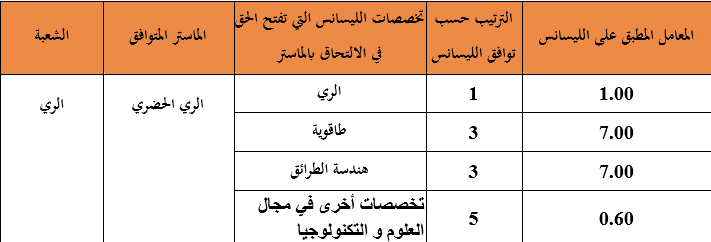
Admission Requirements
Admission Requirements & Enrollment
The University Centre of Maghnia (UCM) offers diverse undergraduate programs open to both national and international applicants, subject to the following regulatory frameworks:
- High School Graduates (Baccalaureate Holders) Prospective students holding a Bachelor’s degree (Baccalaureate) or an equivalent international qualification may apply according to the criteria and procedures updated annually by the Algerian Ministry of Higher Education and Scientific Research.
- Holders of Prior University Degrees (Classic System)
Candidates seeking to advance their studies or specialize further may apply based on available pedagogical capacity and ministerial guidelines. This includes:
- Holders of Prior University Degrees License degree (Classic System).
- Holders of the DEUABaccalaureate + 3 years Classic System)
- Second Degree Candidates
Students who already hold a university degree may apply for a second degree programsubject to seat availability and specific departmental requirements
- International Students (“Study in Algeria” Program)
UCM warmly welcomes international applicants. Admission is granted based on the following:
- The candidate must hold a degree in Baccalaureate degree or an internationally recognized equivalent
- Registration via the official ““Study in Algeria”” (Study in Algeria).
- Prior attainment of an Equivalence Certificate from the Algerian Ministry of Higher Education and Scientific Research.
Important Notes Regarding Tuition Fees:
- Tuition-Free: Education is free for Algerian residents and international students receiving official scholarships from the Algerian Ministry of Higher Education
- Fee-Paying: International students under the “Study in Algeria” program (non-scholarship) are subject to annual fees fees covering tuition, accommodation, and catering, determined by current regulatory decrees.
Structure and Organization of the Training Programme
The Master’s degree program in Urban Hydraulics spans two academic years, distributed over four semesters: the first, second, third, and fourth semesters. The structure of this training relies on a careful balance between advanced theoretical lectures, practical work, and digital simulation, concluding with an applied and research-oriented graduation project deep within the specialization.
Time Structure and Semesters:
The university track consists of 120 credits, divided equally between the two years (60 credits per year, with an average of 30 credits per semester):
- First Year (Master 1): Focuses on building an advanced scientific foundation and understanding fundamental concepts in hydraulics, water networks, and water treatment systems.
- First Semester: Study of fundamental principles in applied hydraulics, hydrological model analysis, and Geographic Information Systems (GIS).
- Second Semester: Deepening knowledge regarding water networks, water treatment and environmental engineering, and digital modeling and simulation.
- Second Year (Master 2): Orientation toward precise specialization and field application.
- Third Semester: Study of complex networks, sanitation systems, water control in smart cities, and sustainable water resource management.
- Fourth Semester: Preparation for a comprehensive graduation project (Master’s thesis) accompanied by a practical internship within an economic institution, municipality, or university research laboratory.
Organization of Teaching Units:
- Fundamental Teaching Units: Cover core knowledge in hydraulics, water networks, treatment, water management, modeling, and digital simulation.
- Methodological Teaching Units: Include practical work, digital programming, the use of HEC-RAS, EPANET, and Matlab/Simulink software, and practical application on water network models.
- Exploratory Teaching Units: Study modern standards and techniques, such as remote sensing and the Internet of Things (IoT) for water.
- Transversal Teaching Units: Enhance linguistic and technical skills, professional ethics, documentary research, and research thesis writing.
Evaluation and Progression System:
- Continuous Assessment: Accounts for 40% of the total grade for theoretical modules, including quizzes, assignments, and practical work.
- Final Exams: Held at the end of each semester, accounting for 60% of the grade for fundamental and methodological modules.
- Compensation and Progression: Subject to university regulations, where the principle of compensation between modules within a teaching unit and across different units in the same semester is applied. A semester is considered acquired if the general average is $\ge$ 10/20.
Culmination of Training (Fourth Semester):
The program concludes with the preparation and defense of a Master’s thesis, with its credits distributed across personal work, the internship, and participation in scientific conferences. Graduation topics typically focus on:
- Applied Field Study: In collaboration with economic partners, such as municipalities, water institutions, or major factories. This includes improving water network performance, resource management, and flood protection systems.
- Academic Study and Digital Simulation: Modeling channels and water resources, designing smart control systems, developing algorithms for flood forecasting and water management in smart cities using modern simulation software.
Following the public defense before a specialized jury, the student is awarded an Academic Master’s degree in Urban Hydraulics, allowing them to directly enter the job market as a hydraulic engineer or pursue scientific research and register for the PhD competition.
Targeted Knowledge
Targeted Theoretical and Fundamental Knowledge:
- Mastery of hydraulics and water resource analysis: A deep understanding of water flow principles in closed and open networks, studying water movement in channels and rivers, and handling urban distribution systems.
- Understanding water treatment processes and quality standards: Studying physical, chemical, and biological water treatment techniques, analyzing water quality, and knowing the requirements for drinking water and sanitation.
- Comprehending hydrological and hydraulic modeling: The ability to analyze rainfall and discharges, forecast floods and droughts, and understand the impact of climate change on water resources.
- Mastering sustainable water resource management: Familiarity with water sustainability plans, flood protection systems, and runoff control in smart cities.
Technical and Applied Knowledge and Skills:
- Design and operation of water supply and sanitation networks: The ability to plan urban water networks, measure performance, and solve loss and waste problems.
- Management of water facilities: Knowing how to operate pumping stations, water tanks, treatment plants, and smart control systems.
- Resource analysis and management via Geographic Information Systems (GIS): Drawing water distribution maps, analyzing spatial data, and using control and monitoring tools.
- Digital simulation of water systems: Using software such as HEC-RAS, EPANET, and Matlab/Simulink to simulate water networks and analyze performance.
Methodological Knowledge and Research & Development Tools:
- Using programming in hydraulic modeling: Object-oriented programming (Python, Matlab) to develop network simulation and data analysis.
- Scientific research and engineering report writing: The methodology of searching for scientific references, writing reports, and preparing graduation theses in an organized academic manner (PFE).
- Applying evaluation and analysis methodologies: Evaluating networks, flow testing, quantity estimation, and analyzing the efficiency of water supply and treatment systems.
Exploratory and Transversal Knowledge (Professional Integration):
- Familiarity with modern urban hydraulics technologies: Such as remote sensing systems, smart water flow monitoring, and the Internet of Things (IoT) in water resource management.
- Linguistic and communication skills: Mastering technical terminology in English for use in scientific research and technical correspondence.
- Adherence to professional ethics: Understanding the principles of academic integrity, engineering work ethics, and intellectual property rights related to water innovations.
Competencies to be Acquired
The second cycle (Master’s) in the Urban Hydraulics specialization focuses on transforming the theoretical knowledge acquired in the first year into professional and practical competencies that directly qualify students to manage urban water projects or excel in applied scientific research.
The key competencies that students will acquire are outlined in the following points:
- Management of Water and Hydraulic Projects: Acquiring a high-level scientific methodology for planning and executing urban hydraulics projects, maintaining water networks, and managing resources effectively.
- Operation and Maintenance of Urban Water Networks: The ability to operate, manage, and maintain water facilities, pumping and treatment stations, and storage reservoirs, ensuring high-quality water and sanitation services.
- Design of Water Supply and Sanitation Networks: Acquiring advanced engineering skills to design water distribution networks, sewage systems, and water channels in compliance with the requirements of smart cities and urban areas.
- Analysis of Water Network Performance: The skill of evaluating water network efficiency, measuring flows, diagnosing faults, and analyzing carrying capacity and fair water distribution.
- Field Supervision of Water Projects: The ability to manage work teams at implementation sites, supervise network installation and the maintenance of pumping and treatment stations, and ensure compliance with engineering and environmental standards.
- Digital Simulation and Hydraulic Modeling: Proficiency in using modeling and simulation software (HEC-RAS, EPANET, Matlab/Simulink) to analyze water networks, forecast floods, and develop innovative resource management solutions.
- Water Quality Control and Network Security: The ability to assess water quality, handle environmental risks, and ensure network protection against losses and contamination.
- Implementation of Smart Solutions for Water Resource Management: The ability to integrate remote sensing systems, Internet of Things (IoT) applications, and artificial intelligence to monitor and improve water management in smart cities.
These competencies ensure the preparation of graduates capable of immediate integration into the professional environments of urban water institutions, or successfully continuing scientific research at the PhD level.
Internships & Capstone Projects
Mandatory internships and supervised projects in the final year of the License and Master’s programs serve as a vital bridge between theory and practice. Students gain immersive field experience, applying scientific methodologies to real-world business challenges while developing essential project management and problem-solving skills.
These opportunities foster professional networking and self-reliance, ensuring a seamless transition into the global workforce
Career Prospects
Target Positions:
- Water Network Planning and Management Engineer: Supervising the planning of water distribution and sanitation networks, improving network performance, and evaluating water flow efficiency in cities and urban areas.
- Water Facility Operation and Maintenance Engineer: Managing pumping and treatment stations, maintaining water reservoirs and irrigation networks, and ensuring the continuity of water and sanitation services.
- Smart Monitoring Systems and Water Resource Management Engineer: Designing and developing remote sensing systems, monitoring water quality, and managing resources using AI and IoT tools.
- Water Resource Protection Engineer: Controlling environmental risks, protecting networks from leakage and contamination, and ensuring water security for cities and facilities.
Employment Sectors and Economic Partners in Algeria:
- Water Authorities and Institutions: Such as the Directorate General for Water, major municipalities, and companies responsible for water distribution and sanitation.
- Industrial Sector: Water treatment plants, power generation stations, cement and chemical factories, and industries relying on advanced irrigation and drainage systems.
- Technology Sector: Companies specializing in remote sensing, smart monitoring, and Geographic Information Systems (GIS).
- Administrations and Ministries: Directorates of Water Resources, municipalities, urban planning institutions, and government research centers.
Academic and Research Prospects:
- Pursuing Higher Education (Doctorate): Enabling high-performing individuals to continue research in hydrology, digital modeling and simulation, smart water management techniques, and contributing to sustainable solutions for water resource control.
- Creating Startups: Thanks to training in entrepreneurship and water project management, graduates can innovate technical solutions in water management, network monitoring, or develop smart applications for sustainable cities, benefiting from university business incubator support.
Postgraduate Opportunities
Academic Prospects and Postgraduate Opportunities Post-Bachelor’s
This program opens broad horizons for students wishing to deepen their academic path, as the obtained Bachelor’s degree provides the following opportunities:
- Postgraduate Opportunities
The current academic program allows for direct enrollment in Master’s degreewhether in the original specialization or moving toward integrated specializations within the same branch
- Global Mobility & Scholarships
Distinguished students can aspire to pursue their postgraduate studies in Prestigious foreign universitiesthrough two pathways:
- Official Partnerships: Within the framework of international cooperation programs and scholarships established by the Algerian Ministry of Higher Education and Scientific Research with partner countries
- Individual Application: Students are eligible for direct enrollment in international universities, in accordance with the academic standards and criteria set by those educational institutions abroad
Support for Academic Success and Continued Studies
Is considered Supervision Cell (Tutorat) A fundamental pedagogical support mechanism aimed at guiding students and facilitating their integration into university life. Its role consists of providing Knowledge-based and Methodological Support It helps students organize their academic path, overcome learning difficulties, and develop self-study skills
The cell acts as a liaison between the student and the administration, providing personalized consultations to build academic and professional project ambitious, ensuring higher success rates and achieving academic and professional excellence for graduates.
Career Readiness
The Job Club at UCM (Job Club) at the University Centre of Maghnia, the primary interactive space for preparing students to enter the professional world. Its role extends beyond the academic aspect to focus on Professional Empowerment Through intensive training in self-marketing techniques, professional CV writing, and confidently navigating job interviews
The club serves as a true bridge connecting graduates to the labor market, providing them with the necessary tools to explore opportunities and build a professional network. This helps narrow the unemployment gap and ensures a swift and successful transition from the classroom to promising career paths
Support for Entrepreneurial Projects
The University Centre of Maghnia serves as a fertile environment for innovation, where efforts have converged to establish an integrated ecosystem for supporting entrepreneurial thinking, led by The University Business Incubator Which works on mentoring innovators and startups from the ‘ideation’ stage to ‘implementation,’ by providing high-quality coaching and specialized consultations to obtain the ‘Innovative Project’ label
Alongside it, stands out Entrepreneurship Development Center (CDE) As a strategic link for developing students’ entrepreneurial skills, in partnership with the National Entrepreneurship Support and Development Agency (NESDA), it focuses on practical training and technical mentorship. The center also includes Technology and Innovation Support Centre (CATI) which ensures the protection of intellectual property and patents
These entities integrate to form a bridge connecting the university to the economic environment, thereby transforming academic projects into promising economic enterprises that contribute to local and national development. This establishes the University Centre of Maghnia as a true hub for shaping the entrepreneurs of tomorrow